
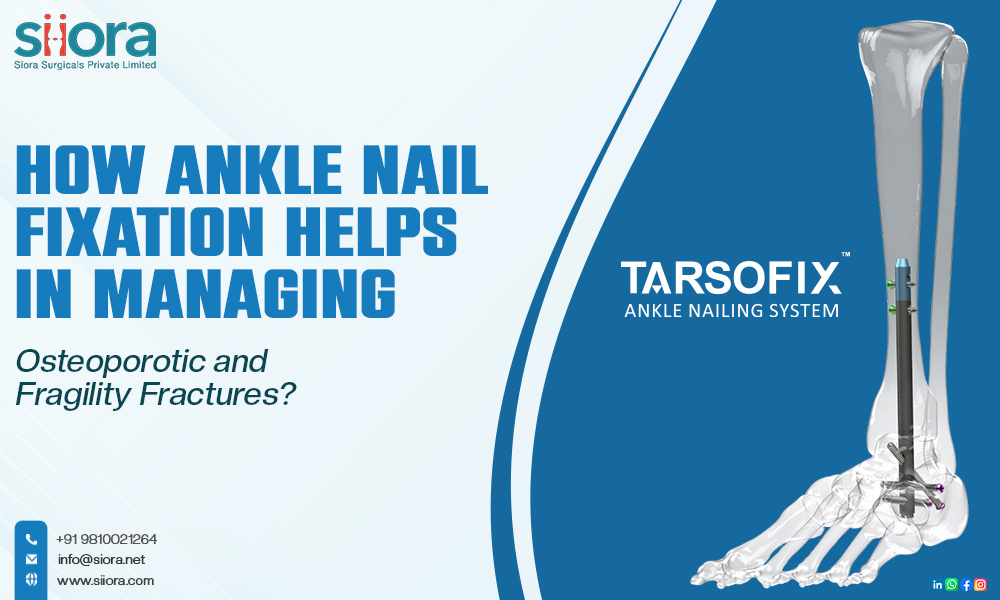
A simple trip and fall can be a minor inconvenience for a young person. But for an older adult with osteoporosis, it can be a life-changing disaster. When they break their ankle, it’s not just a clean crack in a strong bone. It’s a fragility fracture—a break in bone that is soft, brittle, and weak. Fixing this is a massive challenge. It’s like trying to do carpentry with rotten wood. The traditional tools, like plates and screws, can often fail. This is where a powerful and biomechanically superior tool comes into play: the ankle nail.
The Problem with “Styrofoam” Bone
To understand why these fractures are so difficult, you have to understand osteoporosis. It means the bone has lost its density and strength. It’s become porous and weak. Now, imagine trying to put a screw into a piece of styrofoam. It just won’t hold. The threads can’t get a good grip, and with the slightest force, the screw will pull right out.
This is the exact problem a surgeon faces when trying to fix an osteoporotic ankle fracture with a traditional plate. The screws rely on getting a bulldog grip in the bone right at the ankle. But if that bone is as soft as styrofoam, the screws can loosen, back out, or cut through the bone over time. The whole repair can collapse, leading to a failed surgery and the devastating prospect of another operation.
The Ankle Nail: A Different Philosophy of Fixation
An ankle nail, or intramedullary nail, tackles this problem by using a completely different strategy. Instead of putting a plate on the outside of the bone, the surgeon inserts a long, strong metal rod down the center of the bone. This rod acts as a powerful internal splint.
Here’s why this is a game-changer for weak bones:
- It’s a Load-Sharing Device: A plate is a “load-bearing” device. It bears all the stress on one side of the bone. A nail, sitting in the center of the bone, is a “load-sharing” device. It works with the bone, distributing your body weight and the forces of walking along the natural axis of the leg. It’s inherently stronger.
- It Doesn’t Rely on a Local Grip: This is the most critical advantage. The stability of the nail doesn’t depend on getting a perfect grip in the weak, shattered bone at the ankle. It gets its primary stability from being locked into the stronger, healthier bone much further up the shin (tibia).
What does this mean for the Patient?
This superior biomechanical design has massive real-world benefits for an elderly patient with a fragility fracture.
- A More Reliable, Durable Fix: By anchoring in stronger bone and sharing the load, the risk of the implant loosening or failing is dramatically reduced. This gives the patient the best possible chance of a “one-and-done” surgery.
- Earlier Weight-Bearing: The incredible stability of the nail construct often gives the surgeon the confidence to allow the patient to start putting weight on their foot much sooner. For an elderly person, getting out of bed and moving is the number one defense against dangerous complications like pneumonia, blood clots, and severe muscle wasting. A faster return to mobility is a faster return to independence.
- A Kinder Surgery: Ankle nailing is a less invasive procedure than plating. It’s done through smaller incisions, causing less trauma to the already fragile skin and muscle. For an elderly patient, a gentler surgery can mean a smoother, faster recovery.
The Bottom Line
Fixing a fragility fracture isn’t just about putting bone ends together. It’s about outsmarting the weak bone. The ankle nail is a brilliant solution that does just that. By providing a powerful, load-sharing internal splint that anchors in strong bone, this trauma implant offers a stable and reliable fix for the most vulnerable patients. It gives them a real shot at healing correctly the first time and getting back on their feet.
 Siora Surgicals Pvt. Ltd.