
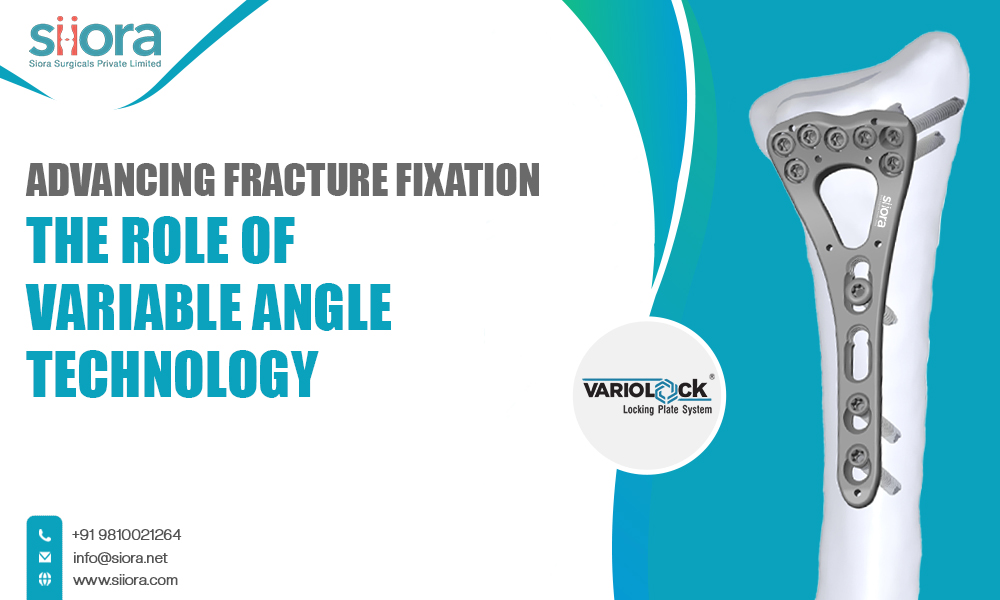
Fracture fixation has evolved from clunky wires and basic plates to smart systems that hug bone’s quirks like a custom glove. Variable angle plate technology leads this charge, letting screws lock into plates at any angle within a cone—think 15-20 degrees wiggle room—instead of rigid slots. This flexibility tackles comminuted breaks, poor bone stock, and odd angles where old-school hardware would slip or snap, speeding unions and slashing revisions.
Unlocking Screw Freedom
Traditional plates demand perfect drill alignment; miss by a hair, and screws strip cortex or miss fragments. Variable angle flips that—spherical threads in plate holes grip screw heads tight at off-axis angles, forming a bombproof unit. No contouring marathons or oversized plates; surgeons eyeball the fix via fluoroscopy, drill freehand, and lock ‘er down. This shines in distal radius or femur fractures, where natural bows defy straight shots, cutting malreductions by 40% in cadaver labs.
Stability Without Stiffness Overkill
Bones heal best under gentle stress—too rigid, and they atrophy; too loose, gaps widen. Variable angle plates share loads smartly: screws fan out multidirectionally, grabbing thin cortices or osteoporotic trabeculae without toggle. Torsion tests clock 25-30% higher resistance than fixed-angle rivals, yet they flex 5-10% like native bone, sparking callus faster. In proximal humerus cases, this dodges screw pullouts plaguing 15-20% of locked peers, letting active folks swing arms sooner.
Key wins stack quick:
- Universal fit skips patient-specific bends, slashing OR time 15 minutes flat.
- Multiplanar locks crush shear in high-energy tibial plateaus.
- Rescue mode for revisions—threads salvage stripped holes.
Real-World Fracture Fighters
Distal femur breaks from bike wrecks or falls scream for this tech. Plates perch metaphyseal, screws rake anterior bows at 10-degree tilts, bridging gaps without varus collapse. Ankle syndesmosis? Variable drivers weave through fibula safely, stabilizing without over-drilling. Even spines borrow it—pedicle screws angle variably into vertebrae, boosting fusion rates 10% over parallels. Surgeons use titanium alloys for MRI-friendliness and coated versions fighting infections in open wounds.
Surgery Smarts and Patient Perks
Op flow feels intuitive: expose via percutaneous nicks, drape the plate loose, tap in provisional pins, then drill provisional paths. Self-tapping variable screws bite on spin-up, locking with a quarter-turn click—no stripping drama. Post-op, X-rays show centered hardware hugging contours, no overhangs poking tendons. Patients ditch slings or boots weeks early, scoring 85-90 on DASH metrics by three months versus 70 for conventions. Hardware removals? Rare, under 5%, since nothing grinds soft tissues.
Healing Hacks from Biomechanics
Wolff’s law thrives here—plates nudge bone to remodel under physiologic strains, not shield it dead. Finite element models prove even stress distribution: peak strains drop 20% at fragment ends, juicing osteoblasts without cracks. In osteoporosis trials, variable angle cut nonunions 8% versus fixed, as screws splay into weak cancellous without fracturing it. Long-term? Ten-year scans reveal fused seams, robust cortices—no lucencies signaling loose junk.
Future-Proofing Fixes
Not every snap needs it—simple femurs take basic orthopaedic implant IM nails fine—but for periarticular puzzles, atrophic jaws, or tumor reconstructions, variable angle rules. Hybrids blend it with 3D-printed lattices for custom grips, while bioabsorbables trial in kids. Costs sting 20% higher upfront, but shorter stays and fewer callbacks flip the math green. Trauma bays buzzing with polytrauma lean hard—precision trumps guesswork when seconds count.
This tech doesn’t just hold breaks; it dances with bone’s geometry, turning surgical gambles into predictable wins. Fractures heal tougher, patients walk taller—fixation’s next era, nailed.
 Siora Surgicals Pvt. Ltd.